RESEARCH
450 Tbps Over London Streets, No New Cable Needed
Japan's NICT pushed 450 Tbps across a live 39-km London metro fiber span, shattering its own record without laying new cable
19 Jun 2026
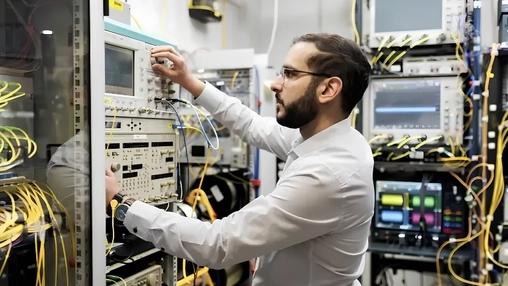
Beneath the streets of London runs fibre that was never meant to carry this much. On June 11th, researchers from Japan's National Institute of Information and Communications Technology pushed 450 terabits of data per second along 39 kilometres of active metro infrastructure, breaking their own prior record of 402 Tbps. No new cable was installed. The gain came entirely from doing more with what already exists.
That distinction is the point. Fibre capacity has long been discussed in terms of physical expansion: more cable, more trenches, more disruption. NICT's result suggests the headroom within existing networks may be considerably larger than the industry had assumed. For carriers managing surging data demand against tight capital budgets, that is a meaningful shift in the calculation.
However, the trial's credibility rests on where it took place. Laboratory demonstrations eliminate signal degradation, physical imperfections, and the general messiness of operational infrastructure. Running the same experiment on live London metro fibre, subject to real-world interference, makes the numbers harder to dismiss. A controlled lab result invites caution; an in-service result invites investment committees.
Practical consequences follow a familiar path. Internet providers, cloud operators, and data centre customers could eventually extract far greater bandwidth from fibre already buried beneath city streets, through software and signal-processing improvements rather than civil engineering. Lower costs and faster deployment are the obvious draws. Spectral efficiency gains of this scale tend to move from research into industry standardisation within a few years, compressing timelines that once stretched across decades.
Fibre's longevity as an infrastructure asset was already well established. NICT's London result extends that argument further, repositioning existing cable not as a constraint to be replaced, but as a resource still being discovered.
Related News


topics on the agenda
SUBMARINE NETWORKS RESILIENCE AND DIVERSITY: ABILITY TO ADAPT
DAY 1: undefined
09:40 - 10:05
PANEL DISCUSSION ON ENHANCING CABLE SECURITY IN A RAPIDLY EVOLVING THREAT LANDSCAPE
DAY 1: undefined
11:00 - 11:30
REDEFINING THE CABLE LANDING STATION: POWER, DESIGN, AND DIVERSITY
DAY 1: undefined
11:30 - 11:55
SUBSCRIBE FOR UPDATES
By submitting, you agree to receive email communications from the event organizers, including upcoming promotions and discounted tickets, news, and access to related events.